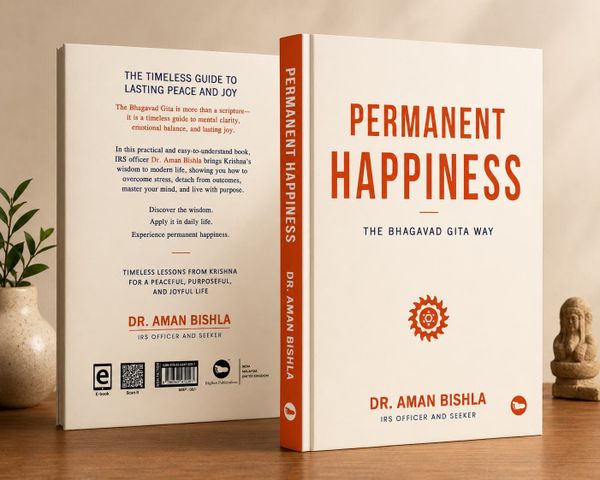
What Is Permanent Happiness?


"Permanent happiness is not a life without pain. It is a mind that is no longer ruled by it."
A Misunderstood Idea
The phrase permanent happiness often sounds unrealistic.
People ask:
"Isn't happiness supposed to come and go?"
"How can anyone be happy all the time?"
"Does permanent happiness mean never feeling sadness?"
The answer to all three questions is no.
Permanent happiness is not permanent excitement.
It is not constant pleasure.
It is not endless positivity.
It is not pretending that suffering does not exist.
Permanent happiness is something much deeper.
It is a stable inner state that remains even while life continues to change.
We Have Confused Happiness with Emotion
Most people use the word happiness to describe an emotion.
"I feel happy today."
"I don't feel happy anymore."
But emotions are temporary by nature.
Joy comes.
Joy goes.
Excitement comes.
Excitement goes.
Sadness comes.
Sadness goes.
Fear comes.
Fear goes.
Every emotion has a beginning and an end.
If happiness is merely another emotion, then permanent happiness is impossible.
Perhaps we have been using the wrong definition.
The Difference Between Pleasure and Happiness
Imagine two people.
The first has everything they once dreamed of:
- A successful career.
- Financial security.
- Luxury possessions.
- Recognition.
- Thousands of followers online.
Yet they constantly feel anxious.
They compare themselves with others.
They fear losing what they have.
Their achievements bring pleasure, but not peace.
Now imagine another person.
They live a simple life.
They work honestly.
They enjoy ordinary moments.
They are grateful without forcing gratitude.
They are not free from problems, but they are free from constant mental conflict.
Which person is happier?
Most of us would choose the second.
Why?
Because somewhere deep inside, we already know that peace is a higher form of happiness than excitement.
The Three Levels of Happiness
To understand permanent happiness, it helps to distinguish three levels.
Level One: Pleasure
Pleasure comes from the senses.
Good food.
Music.
Travel.
Entertainment.
Shopping.
Physical comfort.
Pleasure is valuable.
Life would be poorer without it.
But pleasure always depends on circumstances.
When circumstances change, pleasure changes too.
Level Two: Satisfaction
Satisfaction comes from achievement.
Finishing a difficult project.
Helping someone.
Learning a skill.
Building a successful business.
Raising a family.
Achievement provides a deeper happiness than pleasure because it involves effort and meaning.
Yet even satisfaction fades.
After every achievement, the mind soon asks,
"What's next?"
Level Three: Inner Peace
Inner peace is different.
It does not depend on what you own.
Or where you live.
Or how many people admire you.
It arises from understanding yourself.
When your happiness depends less on circumstances, circumstances lose their power to control your emotional life.
This is the beginning of permanent happiness.
Life Will Still Be Difficult
Many people reject the idea of permanent happiness because they imagine it means never experiencing pain.
But pain is part of being human.
You may lose someone you love.
You may become ill.
You may fail.
You may be misunderstood.
Permanent happiness does not remove these experiences.
It changes your relationship with them.
Think of the sky.
Clouds appear every day.
Some are bright.
Some are dark.
Some bring storms.
Yet the sky itself remains unchanged.
Most of us identify with the clouds.
Permanent happiness comes from discovering that we are more like the sky.
Thoughts and emotions continue to arise, but they no longer define who we are.
Why External Success Isn't Enough
There is nothing wrong with wanting success.
The problem begins when we believe:
"Once I achieve enough, I'll finally feel complete."
History repeatedly proves otherwise.
People have reached the top of their professions and still struggled with anxiety.
Celebrities have millions of admirers and still feel lonely.
Billionaires continue working long after they have more money than they could spend.
If external success automatically created permanent happiness, this would not happen.
Success solves many problems.
But it cannot answer life's deepest questions.
Only understanding can do that.
The Real Source of Suffering
Imagine missing a flight.
One person becomes furious.
Another shrugs and reads a book.
A third sees it as an opportunity to rest.
The event is identical.
The experience is completely different.
Why?
Because suffering is shaped not only by what happens, but by how the mind interprets what happens.
This insight changes everything.
If the mind creates much of our unnecessary suffering, then training the mind becomes more important than controlling every circumstance.
Permanent Happiness Is a Practice
There is no single moment when someone suddenly becomes permanently happy.
It develops gradually.
Each day we become a little less attached.
A little less reactive.
A little less dependent on external approval.
A little more aware.
A little more peaceful.
Like physical fitness, inner freedom is built through consistent practice.
What Permanent Happiness Looks Like
Someone living with permanent happiness still experiences success and failure.
Still feels love.
Still feels grief.
Still enjoys laughter.
Still works hard.
Still dreams.
The difference is that these experiences no longer determine their worth or inner peace.
They participate fully in life without becoming imprisoned by it.
Begin with One Question
You don't have to accept anything written here.
Instead, conduct a simple experiment.
The next time something wonderful happens, observe your mind.
Notice how long the excitement lasts.
Then ask yourself:
"If this feeling eventually fades, what kind of happiness am I truly searching for?"
That question marks the beginning of a very different journey.
A journey away from chasing happiness.
And toward understanding it.
Reflection
Consider these questions quietly:
- What do I usually depend on to feel happy?
- If those things disappeared tomorrow, what would remain?
- Can I begin building a happiness that depends less on changing circumstances?
Don't answer quickly.
Some questions become companions for years.
And sometimes, they change us more than any answer ever could.
Key Takeaways
- Happiness is often confused with temporary emotion.
- Pleasure, satisfaction, and inner peace are different experiences.
- Permanent happiness is rooted in inner stability, not constant pleasure.
- Success enriches life but cannot replace self-understanding.
- Lasting happiness grows through awareness, not accumulation.
Next Article: The Happiness Trap: Why We Keep Chasing More